.svg)
.svg)


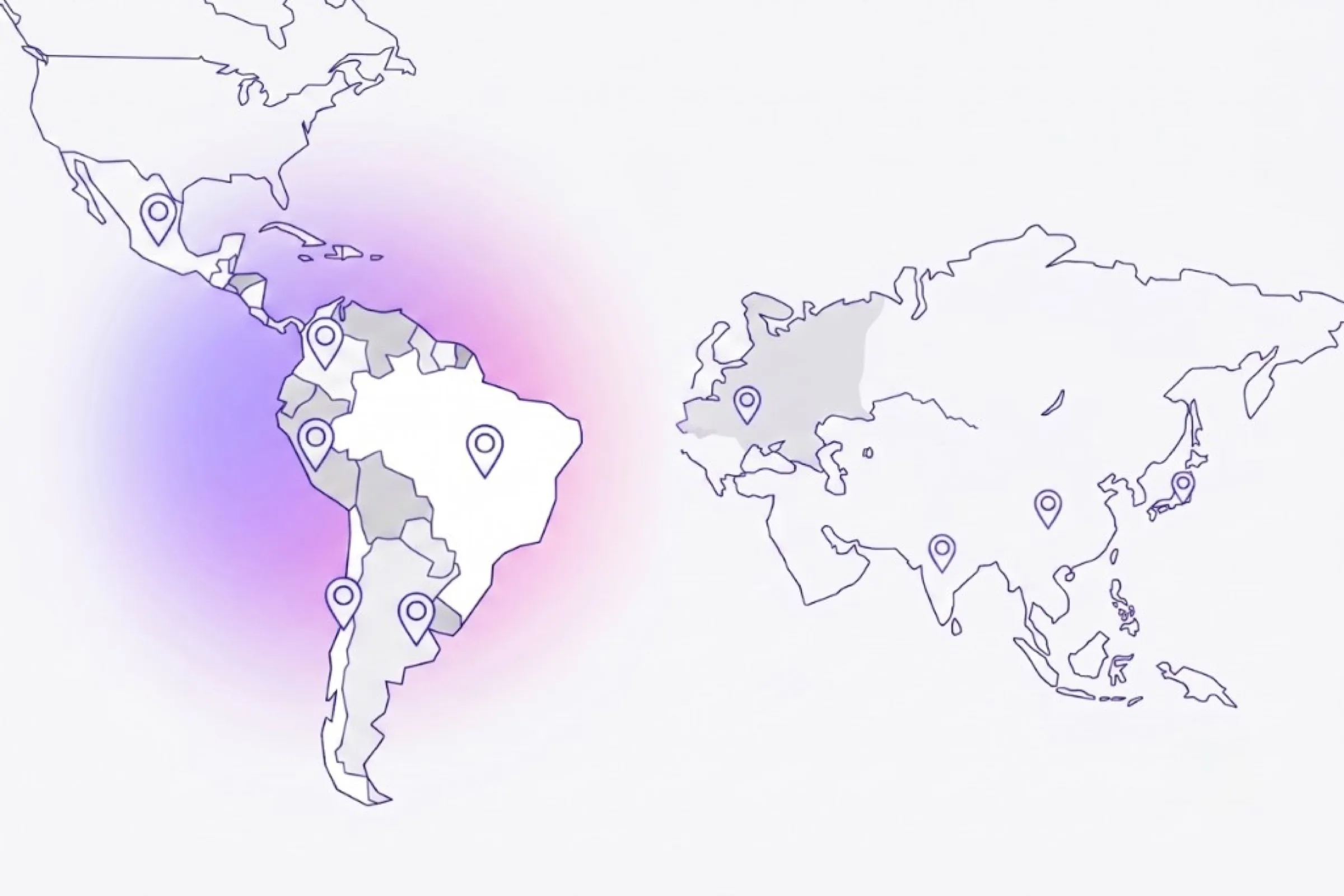
A US engineering team shipping product needs 3 to 5 hours of scheduled overlap with nearshore LATAM developers. AI coding tools speed up writing code, but shipping still depends on same-day review and a live unblock. That overlap is the window that holds a live standup, that review, and that unblock. It is not the maximum the calendar allows. Most LATAM countries can share 6 to 8 hours with a US business day. That country map lives in the LATAM time zone guide.
If you are a CTO or VP Engineering at a Series A through C startup, the hiring problem is specific: you need senior engineers who can ship production code, communicate in English, and sit in your core hours. Domestic supply cannot meet that demand. According to the U.S. Bureau of Labor Statistics, US software developer jobs are projected to grow 15% from 2024 to 2034, roughly five times the all-occupation average.
This page is the operating cheat sheet: how many hours to schedule, what "4 hours overlap with PST" means in a job post, and how to run the window.
Overlap cheat sheet for engineering teams
Time zone overlap is shared working time, not a similar UTC offset. Two engineers can share a timezone on paper and miss each other. Two engineers several hours apart can still overlap if both are at the keyboard during the same window. Count the intersection of two calendars.
Job posts encode this badly. "Must overlap at least 4 hours with PST" and "can you overlap with team working hours" are asking whether the engineer can be online during a named slice of the team's day, usually 9am to 5pm in that zone. They are not asking for 24/7 coverage, and they are not a country list.
How many hours to schedule
Match the window to the work. These are hours you put on the calendar, not the maximum a LATAM country can theoretically share with the US.
A Series A through C product team iterating on features almost always needs the 3 to 5 hour band. Growth pressure does not leave a spare day in the review loop. That window is enough to run ceremonies without asking anyone to work a second shift. Which LATAM country actually produces those hours on a local 9 to 5 is a calendar question, not an hours-to-schedule question.
What the job-post phrase means
Pacific Time is the phrase that shows up most in hiring. A standard Pacific business day is 9am to 5pm local. Four hours inside that window is the bar many West Coast posts set. An engineer working a local 9 to 5 in much of LATAM can hit it. An engineer working a local 9 to 5 in India cannot, unless someone stays late on purpose. Confirm the country can actually hit those Pacific hours before you treat the JD as satisfied.
What Overlap Hours Enable
Time zone overlap determines how much synchronous communication your team can sustain. A 2024 study published in Organization Science found that each additional hour of time-zone separation reduced synchronous communication by 11% at one Fortune 100 firm with over 12,000 employees. The implication: more overlap hours mean more real-time voice and video communication.
For growth-stage teams under pressure to ship and show traction, this translates into three operational capabilities:
Live Standups
With 3 to 5 hours of overlap, your nearshore LATAM developers can attend the same daily standup as your US-based engineers. You do not need to record async updates or wait for written check-ins.
That is how it works in practice at Sharp Performance, a HealthTech company that doubled its engineering team through Remotely. Real Deprez, Head of Engineering, put the crossover in the middle of the day, not at the edge of anyone's morning:
"We've gotten great developers in the door that have no communication problems. Latin America on nearshore is fantastic because we have a good time overlap. They start a little earlier and end a little earlier, so there's a really good crossover time in the middle where we can schedule our standups and ceremonies. Functionally, it doesn't feel any different than working with a local remote team." — Real Deprez
That is the 3 to 5 hour scheduled window: ceremonies in the shared middle of the day, not a follow-the-sun handoff. The full story is in How Sharp Performance doubled its engineering team in six months.
Same-Day Code Review
Pull requests submitted by LATAM developers during their morning can be reviewed by US engineers during the overlap window. You close the feedback loop the same day instead of waiting 24 hours.
Real-Time Incident Response
When production breaks, you need engineers online who can triage, debug, and deploy. Overlap hours give you a shared window for live troubleshooting. You are not paging someone at 3am local time.
AI and Faster Delivery Raise the Value of Overlap
AI coding tools accelerate how fast individual developers produce code. A randomized controlled trial by MIT Sloan-affiliated researchers (Peng et al., 2023) found that developers using GitHub Copilot completed a specific JavaScript coding task 55.8% faster than a control group. That result is scoped to a single task type; not all coding speeds up equally.
Real-world deployment confirms the pattern at larger scale. Field experiments across 4,867 developers (Cui, Demirer et al., 2025) found that AI tool users completed approximately 26% more pull requests per week. The same paper notes that coding is only part of a software developer's job.
The Bottleneck Shifts to Review and Coordination
As AI handles more code generation, the constraint moves to the human work around it: code review, validation, unblocking, and decisions. A June 2026 survey of 1,528 developers and technology buyers (GitLab) found that 85% of respondents agreed AI has shifted the bottleneck from writing code to reviewing and validating it. In the same survey, 79% reported that individual productivity improved while overall delivery did not keep pace.
This is perception data, not measured throughput. But the direction is clear: more AI-generated code creates more review work.
Faster Iterations Compress the Coordination Window
Growth-stage teams are expected to deliver features and improvements at a faster pace. That pressure is about iteration speed, not whether you run sprints, kanban, or something in between. Faster delivery leaves less calendar time for the review-and-feedback loop. The coordination window compresses: each pull request review, architecture decision, and unblocking conversation has to land sooner.
Shared Working Hours Let You Capture AI's Speed Gains
Here is the inference: if AI accelerates code production, the bottleneck shifts to review and coordination. If faster delivery compresses the time available for that work, real-time communication becomes more valuable.
A Harvard/NBER study (Emanuel, Harrington, and Pallais) found that software engineers sitting near teammates received 18.3% more coding feedback and produced higher-quality code. That study measured physical proximity, not time-zone overlap. But it offers a mechanistic analog: shared presence enables real-time feedback loops.
For distributed teams, working-hour overlap is the remote equivalent of shared presence. Teams that share 3 to 5 hours of overlap with nearshore LATAM developers can review, unblock, and decide in real time. Teams separated by 8 to 12 time zones lose those speed gains to multi-day feedback delays.
This is a logical inference, not a proven research finding. No approved study directly compares synchronous versus asynchronous team delivery speeds. But the reasoning follows from the evidence: AI accelerates code, review becomes the constraint, overlap enables real-time review.
For growth-stage startups using AI tools across the stack, nearshore LATAM hiring preserves the coordination bandwidth you need to capture that shipping speed.
Structuring Your Team Around Overlap
Overlap hours are a constraint to plan around, not a problem to solve. Here is how to structure your distributed engineering team:
Anchor Core Hours
Define a 3 to 4 hour window where all engineers are online. For US East Coast teams hiring from Colombia or Peru, 10am to 2pm ET works for most schedules. For US West Coast teams hiring from the same region, 11am to 3pm PT aligns with early afternoon in LATAM.
Front-Load Synchronous Work
Use overlap hours for meetings, pair programming, and live code review. Reserve async hours for deep work, documentation, and tasks that do not require real-time feedback.
Match Time Zones to Team Needs
If your team runs morning standups at 9am ET, you need a country whose local 9 to 5 still covers that hour. If your team is on the West Coast, you need Pacific coverage. Do not guess from the UTC offset alone.
Tools and Practices for Time-Zone Coordination
Managing distributed teams across time zones requires tooling and habits that make the overlap window visible and predictable:
- Display local time in Slack. Configure your chat tool to show each engineer's local time in their profile. This prevents miscalculating the overlap window.
- Maintain a shared team calendar. Include LATAM public holidays and PTO so you plan around availability gaps. National holidays differ by country, so treat them as overlap you lose unless you map them in advance.
- Write deadlines in both time zones. Specify every meeting and deadline in both formats (for example, "Wednesday 11am ET / 1pm BRT") to remove ambiguity.
- Standardize on shared engineering tools. Use a single issue tracker and code review platform (Jira, Linear, or GitHub) so work stays visible across the overlap boundary.
When a Deliberate Time-Zone Offset Makes Sense
Time zone overlap for engineering teams is the right default for collaborative product work. But a deliberate offset, a follow-the-sun model, is the better choice when your goal is continuous coverage rather than real-time collaboration.
If you need 24/7 on-call coverage, global support rotations, or nightly monitoring and batch jobs, you may want engineers whose hours extend beyond your US team's workday. Follow-the-sun on-call distributes incident response across time zones so no one gets paged at 3am.
Nearshore LATAM developers give you a choice. The region sits close enough to US hours for same-day code review and live standups, and you can still stagger hours for extended coverage when the work calls for it. Choose the model that matches the work.
How Remotely Helps You Control Time Zone Alignment
Remotely matches growth-stage US startups with vetted nearshore LATAM developers who can sit in your working hours.
The talent pool is over 7,000 vetted engineers at IC4 to IC6, including both product engineers and the AI engineering roles that actually move shipping velocity. Those roles only convert writing code speed into traction if they share a working day with your US team: same-day review, a live unblock, and a standup in the middle of the day. "AI engineer" is not one job. The AI engineer hiring guide maps the five roles hiding inside that title so you hire the right one into the overlap window.
You do not vet developers yourself. Every engineer is already in the pool because they cleared a personal interview. You name the overlap and the role. Remotely matches from that pool within 48 hours, sequences the shortlist, and schedules the interviews. You review profiles and decide. Screening, logistics, and calendar work stay off your plate. There is no recruiting ops layer to stand up on the HR side.
Here is how it works:
- You specify overlap and the role. Core working hours, the minimum shared window, and which AI engineering type you actually need.
- You hire from a vetted pool. Candidates are already interviewed and profiled for IC4 to IC6 seniority, startup experience, English fluency, and fit for the work.
- Remotely runs the path to interview. Shortlist in 48 hours, sequenced and scheduled. You show up to the conversation.
- They join your overlap window. Contractors work directly with your engineers, reporting to your managers. You run standups, assign tickets, and review code in the shared hours.
If you are scaling a Series A through C engineering team and need senior developers, including AI engineers, available during US working hours, Remotely is the partner that matches them into that window.
Frequently Asked Questions
What does 4 hours overlap with PST mean?
It means four of the engineer's working hours fall inside a Pacific business day, usually 9am to 5pm Pacific (UTC-8 in winter, UTC-7 in summer). Ask which four hours. 9am to 1pm PT is a morning pairing window. 1pm to 5pm PT is an afternoon review window. Those are different jobs.
How many hours of overlap do US engineering teams need with LATAM developers?
Schedule 3 to 5 hours of core overlap for product engineering: standup, same-day review, live unblock. Pairing and incidents want 4 to 6. Two to three hours covers a standup and async tickets. That is the window you put on the calendar. Most LATAM countries can share 6 to 8 hours with US East Coast on paper. That is the calendar maximum, not the hours you schedule.
Which LATAM countries have the most time zone overlap with the US East Coast?
Colombia, Peru, and Ecuador have the tightest East Coast alignment. Mexico and Central America align with US Central Time. Brazil and Argentina sit later and still cover East Coast mornings. The full country table, UTC offsets, DST, and ET/PT hour counts are in the time zone guide.
How does LATAM time zone alignment compare to India or Eastern Europe?
LATAM can share a real working day with US teams. India Standard Time (UTC+5:30) is 9.5 to 10.5 hours ahead of US Eastern, which leaves almost no shared hours unless someone stretches. Eastern Europe (UTC+2 to UTC+3) is 6 to 8 hours ahead of ET, so overlap is limited to the US early morning. Nearshore LATAM gives you a same-day window for live review and standups. Distant time zones do not. The hiring-model comparison is in nearshore vs offshore.
Does LATAM observe daylight saving time?
Most LATAM countries do not. That is why the overlap window stays stable across seasons. A few countries do observe DST, so confirm the local calendar before you hire.
What is the best way to coordinate code reviews and on-call across US and LATAM time zones?
Anchor a 3 to 4 hour core overlap window for synchronous code review and pairing. Submit pull requests before the overlap window so US and LATAM engineers can review the same day. Use the shared window for architecture decisions and unblocking. Structure on-call so the overlap hours cover peak US traffic and hand off cleanly.
Does using AI coding tools reduce the need for time-zone overlap?
No. AI coding tools increase the value of overlap. When AI accelerates code generation, the bottleneck shifts to human work: code review, validation, and decisions. In a June 2026 GitLab survey of 1,528 developers and technology buyers, 85% agreed AI has shifted the bottleneck from writing code to reviewing and validating it. Faster code output creates more review work. Teams that share working hours can review, unblock, and decide in real time. Teams separated by many time zones lose AI's speed gains to multi-day feedback delays.
Sources
BLS Occupational Outlook, Software Developers, QA Analysts, and Testers · The Hidden Cost of Working Across Time Zones, Organization Science · The Impact of AI on Developer Productivity: Evidence from GitHub Copilot, Peng et al. 2023 · The Effects of Generative AI on High-Skilled Work, Cui, Demirer et al. 2025 · GitLab Research: Organizations Are Generating AI Code Faster Than They Can Control It, June 2026 · The Power of Proximity to Coworkers, Emanuel, Harrington, and Pallais, NBER