.svg)
.svg)




Healthcare technology leaves no room for a disconnected engineering team.
Every engineer needs to understand the product, protect sensitive patient data, work alongside the rest of the company, and take ownership beyond the next sprint.
AmplifyMD built that team with Remotely.
What began with one engineer in December 2021 has grown into 23 engineers on AmplifyMD’s team today. Across 32 total hires, 72 percent are still with the company. The active team averages 2.3 years of tenure, with Remotely supporting AmplifyMD and its engineers long after each hire.
Together, they built a platform that doubled TeleHospitalist consults per shift, reduced TeleStroke operating costs by 52 percent, and cut outpatient specialty wait times from months to days.
They aren’t a separate contractor team. They’re AmplifyMD engineers.
About AmplifyMD
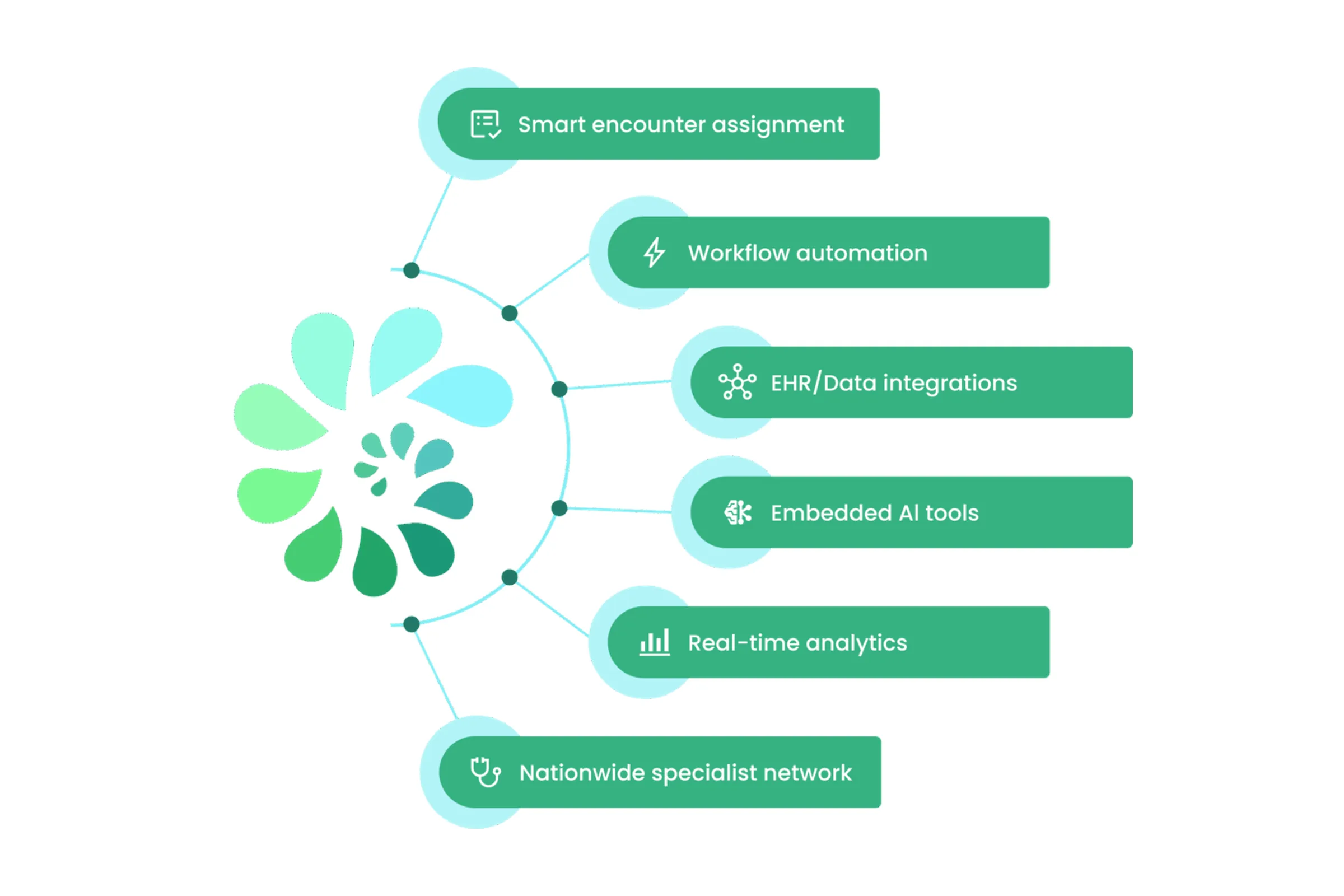
AmplifyMD gives hospitals one platform for managing virtual care.
The platform connects directly with hospital medical record systems, so care teams can work without adding separate software. AmplifyMD also partners with a network of doctors spanning more than 15 specialties and all 50 states.
The company secured its Series B in 2025. Its investors include Greylock (who introduced AmplifyMD to Remotely), Forerunner Ventures, F-Prime Capital, Tau Ventures, and strategic partner Memorial Hermann Health System.
CTO Nijay Patel joined in 2021 to lead engineering. Four and a half years later, AmplifyMD has 23 engineers hired through Remotely, and its first hire is still building the platform.
The challenge
AmplifyMD had already tried India. The quality was there; the time zone was not. The working hours made it difficult to operate as one team.
“I’m Indian, we have a lot of connections there, and they did a great job, but the time zone was really killing it.”— Meena Mallipeddi, CEO and co-founder at AmplifyMD
AmplifyMD needed engineers who could collaborate during the US workday, understand healthcare technology, and operate inside a company responsible for protected health information at scale.
That combination was hard to find.
“Finding individuals who have experience working within healthcare or healthcare technology is really challenging. It’s a smaller talent pool and there are a lot of startups and organizations competing for that talent.” — Nijay Patel, CTO at AmplifyMD
The hiring bar extended beyond technical ability. AmplifyMD is SOC 2 Type II certified, HIPAA compliant, and pursuing FedRAMP certification. Every engineer needed to work within that security environment from day one.
“There is a lot that could go really wrong for a lot of people if there’s a data breach or a security incident. Security is a big deal for us, and we would not do anything to jeopardize that.” — Meena Mallipeddi
The solution
A Greylock investor introduced AmplifyMD to Remotely after seeing the model work across other portfolio companies.
Meena vetted Remotely as carefully as AmplifyMD would vet an engineer. She found a partner capable of building with the company over the long haul.
The first engineer joined AmplifyMD in December 2021.
“It was very clear it was a high-quality outfit, and that we’d find a partner that understood where we were coming from but could also grow and scale with us as we got bigger.” — Meena Mallipeddi
Focusing the search on nearshore LATAM solved the working-hours problem. Today, 81 percent of AmplifyMD’s hires through Remotely are based in Brazil, giving them substantial overlap with their US teammates.
But geography only opened the talent pool. AmplifyMD still controlled the hiring decision.
Every candidate completed the same case studies, coding exercises, and interviews expected of any other AmplifyMD engineer. The company evaluated technical ability, startup mindset, communication, healthcare experience, and comfort with ambiguity.
“We vet them exactly the same way as if they’re an engineer from Stanford located in the Bay Area. They’re doing the case studies, the coding exercises, the personality-fit interviews. We’re checking they can hack it in a startup, handle ambiguity and fast-paced movement, and that they can handle our two-week sprints consistently and with high quality.” — Meena Mallipeddi
Remotely handled sourcing and initial vetting around AmplifyMD’s specific needs. AmplifyMD chose who joined its team.
That combination made it possible to move quickly without lowering the bar. Between January and May 2026, AmplifyMD added six engineers—its largest expansion through Remotely to date.
“When we do need to scale up and identify additional folks to join our team, we can move really fast. Candidates have been pretty thoroughly vetted, not just generally as developers, but specifically for our organization and culture.” — Nijay Patel
One Engineering Team
Traditional staff augmentation keeps contractors at arm’s length. AmplifyMD built its engineering team differently.
Engineers hired through Remotely join sales calls, learn directly from customers, contribute to product strategy, and bring forward solutions before anyone assigns the work.
“The big advantage of having individuals who are really integrated into the organization and approaching their work as being part of the company and in alignment with the mission is that you can start to have a more bottom-up structure for innovation.” — Nijay Patel
The integration extends beyond video calls. Nijay visits Brazil roughly twice a year. Engineers travel to the US for important launches and annual all-company offsites. AmplifyMD and Remotely also hold joint R&D off-sites in São Paulo.
That proximity has helped the team build the relationships and shared context required for long-term ownership.
“We really wanted a team that would work with us as part of our team, not a third-party contractor. Our goal was always to have an engineering team that was Amplify, not ‘this is Amplify and this is our contracted engineering team.’” — Meena Mallipeddi
Engineers Who Stay and Lead
The active engineering team averages 2.3 years of tenure.
Fourteen of AmplifyMD’s 23 engineers hired through Remotely have been with the company for more than two years; eight have passed three years. The first engineer hired in 2021 is still building.
Some engineers joined when AmplifyMD had fewer than 10 employees. They have since moved into leadership roles across product and engineering.
They understand the platform’s history, the customer, and the company’s go-to-market strategy. That gives them enough context to challenge decisions and help leadership sharpen the company’s direction.
“It’s been amazing to see the pull from a number of those individuals to help us refine our strategy and our narrative, holding us accountable as leaders to having a clear direction and vision, and being collaborative in that process, bringing ideas forward.” — Nijay Patel
Their location does not change the standard or the quality of their work.
“Quality-wise, they’re on par. They’re fantastic. Just because they’re from location A versus location B, it’s not different. A true engineer creates a product that people can understand solely from their notes. It has to be efficient code, with clear documentation, and we found that with Remotely just as much as we have in the US.” — Meena Mallipeddi
That retention created its own hiring advantage. Engineers referred trusted colleagues from their networks, helping AmplifyMD reach more strong candidates and expand faster.
The Impact
The strongest proof is the product this team built.
AmplifyMD’s platform now helps hospitals:
Complete twice as many TeleHospitalist consults per shift.
Reduce TeleStroke operating costs by 52 percent.
Cut outpatient specialty wait times from months to days.
Connect virtual care directly with existing medical record systems.
Deliver care across more than 15 specialties in all 50 states.
These results came from engineers who understood the product and stayed long enough to keep improving it—not contractors rotating through isolated projects.
Talent First. Geography Second.
AmplifyMD has remained fully remote by design. Its 60-person team is now split evenly between the US and other countries.
Some health systems initially questioned whether international engineers could work within their security requirements. AmplifyMD addressed those concerns through approved-country access, documented use cases, and clear explanations of its HIPAA and SOC 2 controls.
The company hires around the role, not a predetermined location.
“We don’t necessarily perceive it as US-based versus South America. Instead it’s, where is the talent? Is there a good cultural fit? Is this someone we want to work with every day? Can they seamlessly communicate and engage with our customers?” — Meena Mallipeddi
The conversations have become easier as nearshore engineering teams have become more common across the industry.
“It certainly has become much, much easier. There isn’t an organization to date that we’re working with that flat out prohibits that.” — Nijay Patel
Behind the engineering team, Remotely manages the infrastructure required to hire and retain internationally—from initial vetting through contracts, compliance, payroll, and ongoing support.
Meena’s shorthand is simple:
“How would I explain Remotely to someone looking at it? I’d say it’s your HR partner for all your international hires.” — Meena Mallipeddi
Key Learnings
AmplifyMD no longer divides its talent strategy into US and international hiring.
The questions are more useful now:
Can this person meet the technical bar? Do they understand the customer? Can they communicate clearly? Will they take ownership as part of the company?
Talent comes first. Geography comes second.
That approach works because AmplifyMD did not use nearshore LATAM to create a separate delivery team. It used Remotely to extend its own engineering team with senior people who could collaborate, lead, and stay for the long haul.
Looking Ahead
With its Series B secured, AmplifyMD is investing in AI and LLM capabilities, deeper EHR integrations, and the specialized healthcare engineering required to turn a virtual care platform into a clinical operating system.
Its hiring needs are becoming more specialized, shifting from generalist full-stack roles toward healthcare-domain and AI-native engineering.
AmplifyMD plans to build this next chapter the same way it built the first: by carefully choosing engineers who join the mission, not just the project.
“Here’s a model where we can identify folks and bring them onto our team, not as contractors focused on specific projects, but to be part of our mission and journey together in growth, partnership, and engagement.” — Nijay Patel
Key Results
23 engineers on the team today: AmplifyMD grew from one hire in December 2021 to 23 active engineers, across 32 total hires.
2.3 years average tenure: Fourteen active engineers have passed two years, eight have passed three, and the first engineer hired in 2021 is still building.
72 percent retention: Nearly three-quarters of everyone AmplifyMD has hired through Remotely remains with the company.
2x TeleHospitalist throughput: The platform doubled cross-cover consults per shift.
52 percent lower TeleStroke operating costs: The team improved care delivery while reducing operational overhead.
Months reduced to days: Hospitals can give patients faster access to outpatient specialty care.